

There’s a moment early in every startup - before the product works, before the customers arrive, before any of it makes sense - where a rational person would stop.
The data isn’t there. The market’s half-formed. The competitors have more money, more people, more runway. You’re running on conviction and a pitch deck that has more assumptions than facts.
And yet you proceed. That’s not courage, exactly. It’s something closer to selective blindness - a refusal to fully register the odds. This sounds like a character flaw until you realise it’s basically the job.
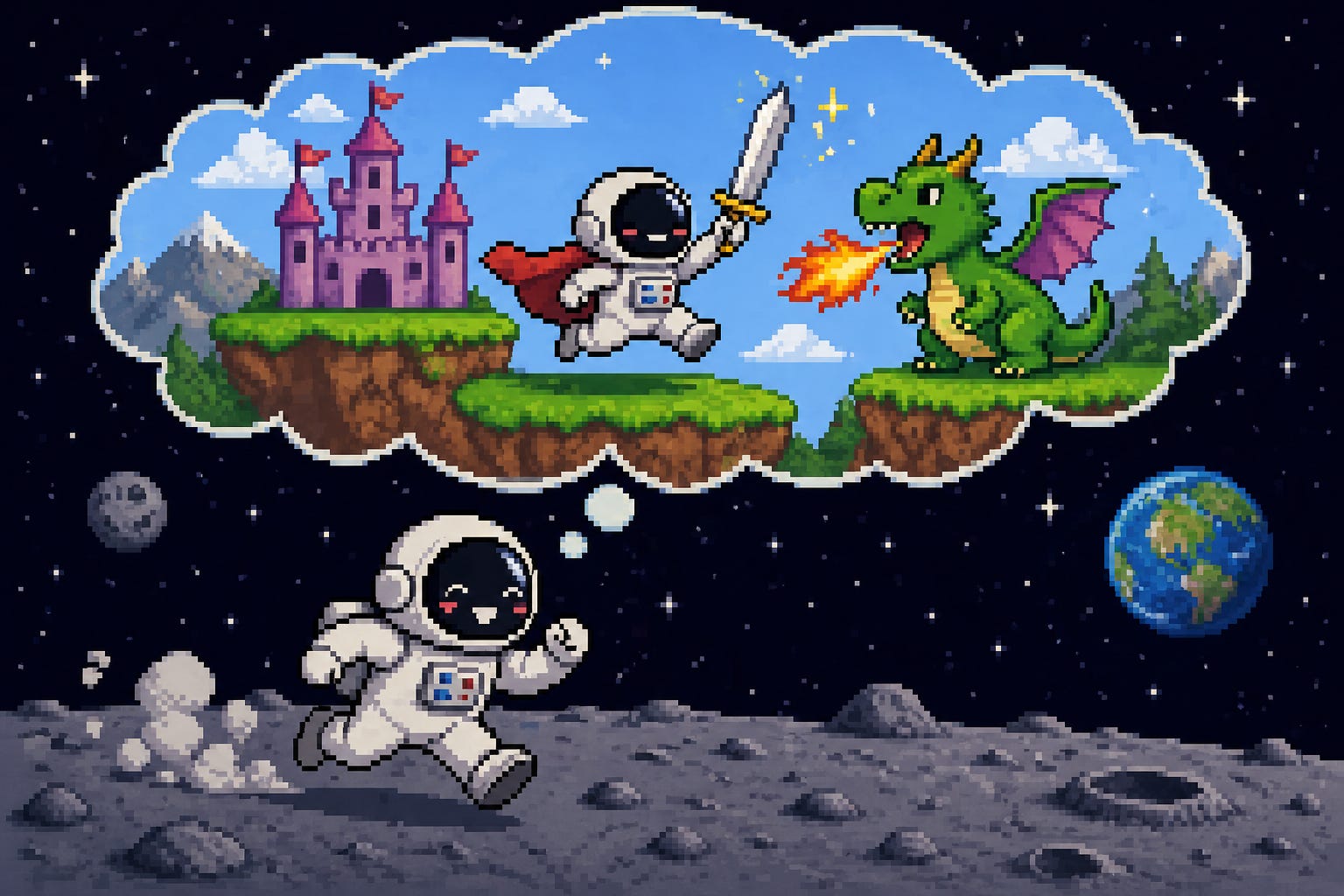
Here’s something that doesn’t get said enough: most founders are, at the start, at least a little delusional. They believe their timing is right when the evidence is ambiguous. They believe talent will show up when they can barely make payroll. They believe the market will come around - they just need a bit more time.
If you ran these beliefs through a Bayesian update, you’d walk away. Most startups fail. Most new technologies underperform projections. Most timelines slip by years, not months. The base rates are bad.
Founders override the base rates. That’s not a bug.
That mild delusion does something useful: it compresses fear enough that you actually move. It makes people want to join you, because no one rallies around a probability curve - they rally around someone who genuinely believes. It gives you the emotional insulation to operate in conditions where external validation simply doesn’t exist yet.
You can’t build a non-consensus company on consensus confidence.
But here’s where it gets complicated.
The same trait that gets you started can slowly become the thing that kills you. Optimism - the useful kind - says “this is hard but solvable.” At some point, without you noticing, it can shift into something else: “reality will eventually agree with me.”
That’s a different thing entirely.
When that shift happens, poor signals get explained away. No traction becomes “market education lag.” Investor hesitation becomes “they don’t get it yet.” A product that doesn’t fit becomes a positioning problem. Every warning light gets re-labelled as temporary noise.
In the early days, that kind of persistence looks like vision. Later, it starts to look like denial. The founder who wouldn’t quit too early also won’t pivot when they should.
The frustrating thing is that you can’t always tell which one you’re watching - in real time, from inside it.
Plenty of companies looked completely delusional before they weren’t. Investors passed. Customers didn’t buy. Smart people said the model was broken. And then something shifted, and it worked. So founders reasonably conclude: this is just what the in-between period feels like.
Sometimes it is. Sometimes it isn’t.
That ambiguity is structural. It doesn’t resolve cleanly. And that’s why delusional optimism is simultaneously the fuel of breakthrough and the camouflage of a slow failure.
The founders who seem to navigate this best aren’t the ones who eliminate the delusion. They’re the ones who compartmentalise it.
They hold two things at once: deep emotional conviction about where they’re going, and genuine intellectual scepticism about how they’re getting there. The destination is fixed. The path is always under review.
They run pre-mortems. They invite people to poke holes. They watch the metrics honestly, even when the metrics are uncomfortable. They’ve figured out how to separate their identity from the product - so that changing direction doesn’t feel like admitting they were wrong about everything.
The belief energises the company. The belief does not dictate the roadmap.
There’s no clean resolution here. That’s the honest answer.
Without some degree of irrational conviction, most founders would never start. With too much of it, unchecked, they run long past the point of compounding - burning capital and time on a thesis that stopped being true some time ago.
You need enough optimism to attempt the improbable. You need enough honesty with yourself to notice when improbable has quietly become impossible.
The goal isn’t to kill the delusion. The goal is to aim it carefully - and keep one part of your brain that refuses to be convinced by your own story.
That second voice is harder to maintain than the belief. But it might be more important.