

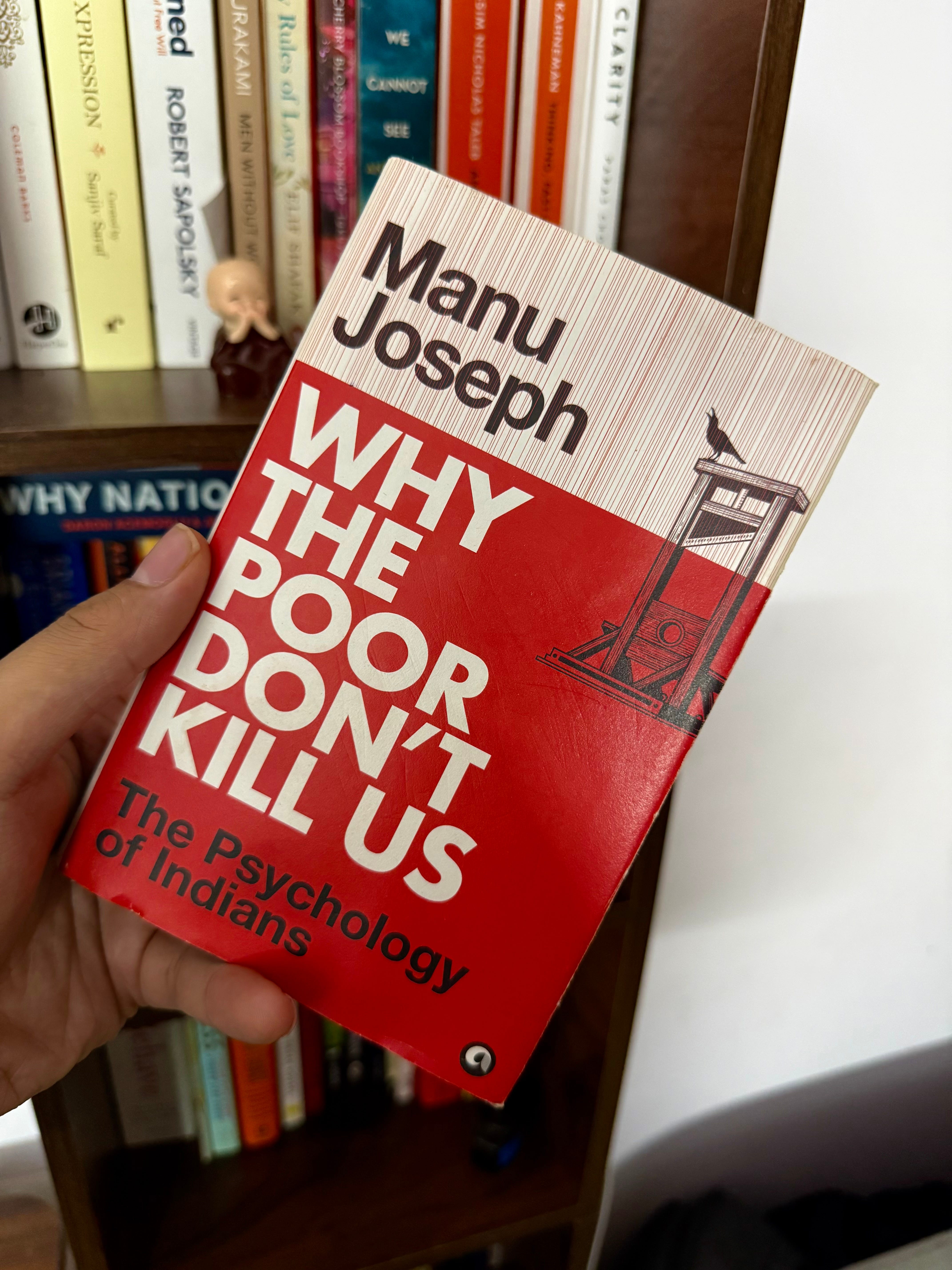
Manu Joseph is India’s sharpest literary wit. This, his first non-fiction, contains some of the most pitiless sentences written about Indian society in recent memory. Which is precisely why it disappoints - not the way bad books do, but the way a brilliant man does when you realize his brilliance has an escape hatch.
The question is genuinely radical: why, in one of the most grotesquely unequal societies on earth, do the poor not revolt? Why don’t the maids who squat beside kitchen sinks pull out the hair of their conscientious madams? Joseph has the nerve to say out loud what every South Delhi living room has silently asked and immediately suppressed. That nerve deserves credit.
But the book answers the wrong version of its own question.
Joseph’s real project, once you strip away the dark comedy, is sociological reassurance. He is explaining - to a reader who is very much us and not them - why we are safe. The “so far” he appends to that conclusion is doing enormous moral work for two words. It gestures at threat without committing to alarm. The drawing room reader finishes the book feeling they’ve engaged with something dangerous, while having been fundamentally comforted.
The most dangerous books about inequality make their readers feel implicated. This one makes them feel curious. Not the same thing.
His sharpest observation - that the poor don’t envy the rich, they envy each other - is genuinely brilliant and genuinely chilling. Envy between equals, not across distances. Which means the system isn’t maintained by force or ideology but by the architecture of aspiration itself. The poor are too busy competing laterally to organize vertically. Joseph notices this, turns it over, admires it, and sets it back down. He never follows it to where it leads: that this architecture was not accidental.
The grenade stays unpinned.
His contempt for professional humanitarians has attracted predictable criticism from predictable quarters. Wrong target. The more honest critique is that Joseph lampoons activists because it’s safe - even fashionable - in the circles where this book will be celebrated. It’s far riskier, and far more interesting, to ask whether the system he describes so acidly has any exit. He doesn’t go there. He has decided there isn’t one. This gets presented as intellectual honesty. It functions as intellectual comfort.
Diagnosing a problem you don’t believe can be solved isn’t courage. It’s resignation in a very good suit.
At its core, Why the Poor Don’t Kill Us is a book by a privileged man, for privileged readers, about why they should stop feeling guilty without stopping feeling intelligent. The poor don’t kill us, Joseph concludes, for reasons of psychology, aspiration, and the peculiar human capacity to find meaning in suffering. He’s probably right. What he never asks is whether the peace is just, or merely convenient.
He understands it brilliantly. He is not disturbed by it. And by the last page, neither are you.
That’s the problem.
Read it. Then read it again and notice what it didn’t make you feel.